Makhzun IMS
Arabic RTL inventory and asset management system for a Saudi government ministry — Angular 22 and .NET 8 with warehouse-scoped multi-tenancy, serial tracing, and 14 PDF reports.
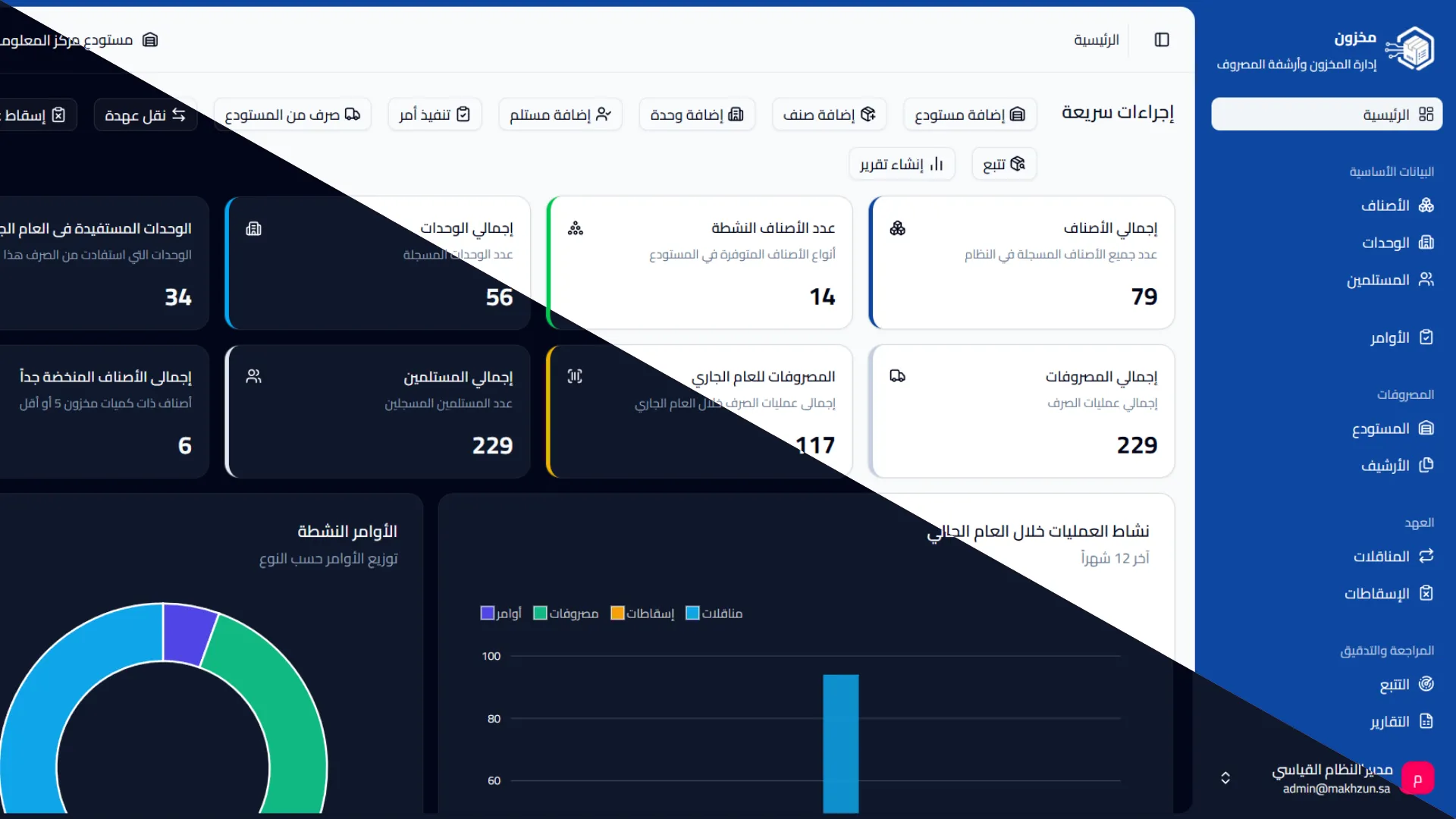
Makhzun (مخزون) is a warehouse and inventory management system built for a Saudi government ministry, covering the full lifecycle of inventory items across military and administrative units — two repositories, one Angular frontend and one .NET backend.
Before — inventory moved on paper and spreadsheets: items arrived against purchase orders, were handed to units, and custody changes were written down by hand. Nobody could trace a serial number, prove who held an item, or run a report for just one warehouse.
After — every item moves through a governed workflow (inbound orders → dispenses → custody → transfers → returns), each serial number is traceable end to end, and each warehouse sees only its own stock while the ministry keeps a single source of truth.
- Warehouse-scoped multi-tenancy — one shared database with
row-level
WarehouseIdscoping; theX-Warehouse-Idheader is never trusted blindly but validated server-side against active membership, so a forged header is rejected rather than leaking another warehouse’s data. - Custody workflow — transfers and returns move through explicit statuses (Pending → Accepted/Declined) with Hijri and Gregorian dates, and a warehouse-keeper handover reassigns active orders with a rollback endpoint.
- Exactly one keeper per warehouse — enforced in the database with a filtered unique index, not just in application code.
- Serial-number tracing — search any serial to follow an item from inbound order through dispense, custody, and transfer.
- Clean Architecture backend — .NET 8 with CQRS via MediatR,
FluentValidation pipeline, Mapster, and 89 EF Core migrations applied
automatically at startup; controllers stay thin and return a
consistent
ApiResponsewrapper. - Token-free frontend auth — JWT delivered as an httpOnly cookie
with refresh-token rotation, so no access token is ever written to
localStorage. - 14 PDF reports — QuestPDF reports for serials by unit, dispenses by order, custody transfers and returns, remaining quantities, and more, all scoped to the requesting warehouse.
- Audit and backup — an operations-log middleware records changes, and admins can back up and restore the database from the UI.
- Warehouse keepers — receive inbound orders, dispense items, and hand custody over between units.
- AdvUsers — create and manage transfers and returns within their assigned warehouse.
- Administrators — manage warehouses and users globally, review custody, and run reports across every warehouse.
The frontend is Angular 22 with standalone components, zoneless change detection, and signals, styled with Spartan UI over Tailwind CSS v4 and daisyUI, with TanStack Table for data grids, ApexCharts for the dashboard, and dayjs with Hijri calendar support. The backend is .NET 8 following Clean Architecture (Domain → Application → Infrastructure → API) with SQL Server, EF Core, ASP.NET Core Identity, Serilog, and QuestPDF.
- Custody of every item is provable — who holds it, since when, and through which transfers.
- Cross-warehouse isolation is enforced in SQL and in middleware, not merely hidden in the interface.
- Reports that once took manual reconciliation are generated as PDFs scoped to the right warehouse.