Dealzgy Admin Dashboard
Back office for a price-comparison platform — Angular 19 with PrimeNG and ApexCharts, scraping monitoring, a curated bilingual catalog, and Keycloak role-based access.
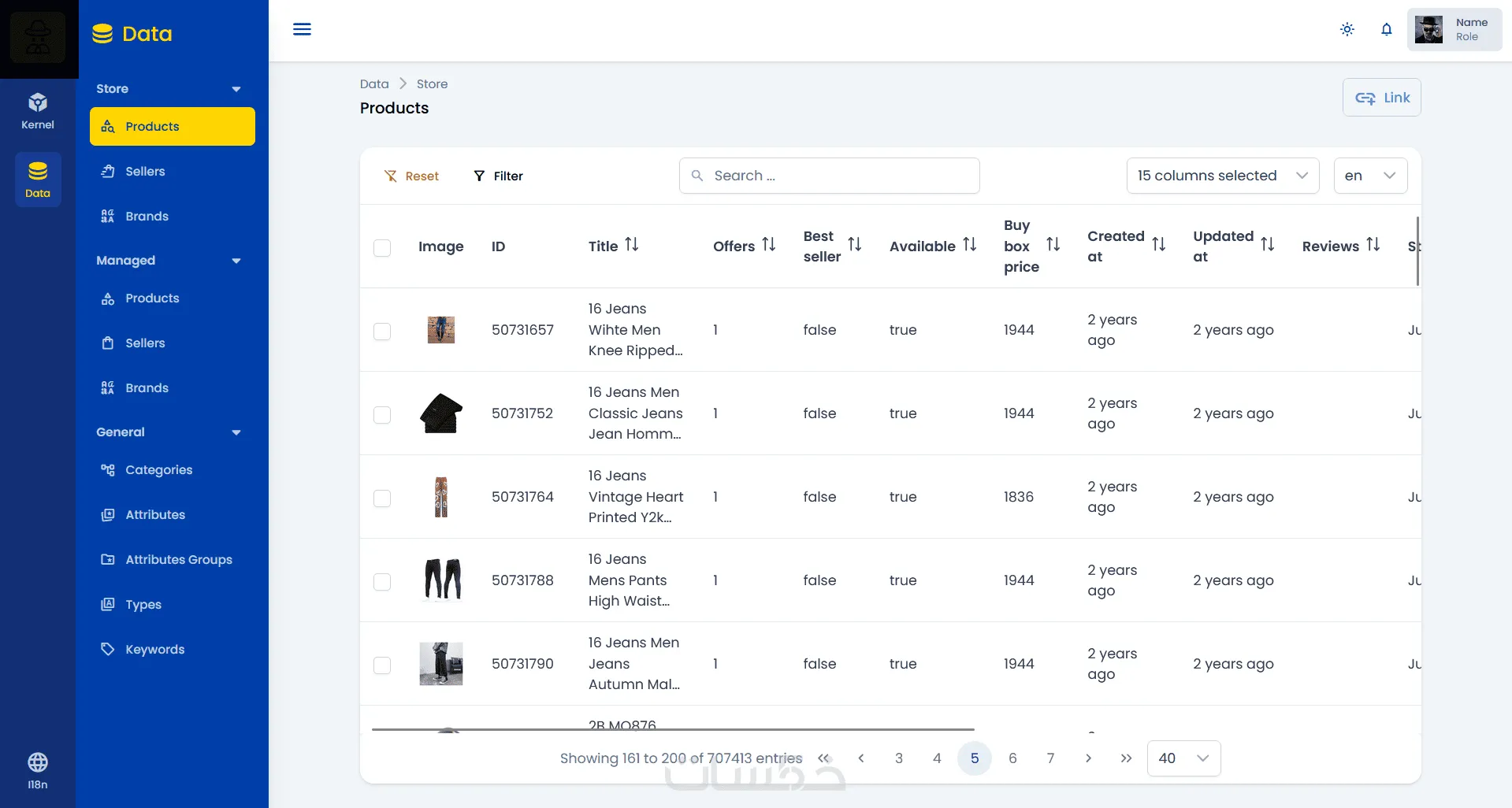
The internal admin dashboard for Dealzgy, a price-comparison and product-aggregation platform — the back office where the scraping pipeline is operated and raw listings are curated into a canonical catalog.
Before — scraped data arrived continuously from thousands of stores, but the pipeline had no visibility: nobody could see which stores were failing, how fast workers were going, or why two listings were not being matched to the same product.
After — one dashboard shows scraping health in real time and gives curators the tools to resolve raw store products into managed catalog entities with bilingual content, brands, categories, and attributes.
- Scraping monitoring — status heatmaps, treemaps, rate pies, and time-series for scraping attempts, with quick, full, deep, and hot views per store.
- Pipeline operations — workers (capacity, Manual/Auto modes, per-store assignment), a proxy pool, scheduled jobs, and priority rules managed from one navigation.
- Two-tier catalog — raw scraped store products (buy-box price, rating, reviews, seller offers, price history) kept separate from curated “managed” products, with explicit linking between the two for entity resolution.
- Bilingual content management — managed products carry
en/arlocalized content withdir="rtl"toggles in the product views, alongside brands, categories (tree), attributes, attribute groups, types, and keywords. - Keycloak role-based auth —
keycloak-angularwith login-required guards, auto token refresh, an inactivity logout, and a role guard that routes unauthorized users to a forbidden page. - Runtime configuration — the app bootstraps by fetching
configs/config.json, whichdocker-entrypoint.shfills withenvsubstat container start, so API and Keycloak URLs are injected per environment instead of baked into the bundle. - Curated product detail — gallery, properties, Quill 2 rich-text content, and the list of linked store products in one view.
- Data curators — match store listings to managed products and maintain bilingual catalog content.
- Platform operators — watch scraping success and failure rates, adjust rate limits, and manage workers, proxies, and jobs.
- Category and attribute owners — maintain the category tree, attribute groups, and keyword sets.
Angular 19 with standalone components, OnPush change detection, and
signals; PrimeNG 19 with a custom theme over Tailwind CSS v4; ApexCharts
via ng-apexcharts for the monitoring visualizations; Quill 2 for rich
text; and Keycloak for identity. Deployed as a multi-stage Docker image
served by nginx, with GitHub Actions building and pushing to a Vultr
container registry on dev, staging, and main.
- Scraping failures surface as charts instead of as silent gaps in the catalogue.
- Raw listings and curated products are linked explicitly, so the comparison layer stays trustworthy.
- Environment-specific URLs are injected at container start rather than rebuilt per environment.